
Become Better at Personal Advocacy
Build skills you can continue using across different situations.
Personal advocacy is not only something you use when a problem appears. It is a collection of habits and capabilities that can become stronger over time.
You can become better at noticing when you need clarification, preparing before important interactions, asking useful questions, organizing information, keeping track of next steps, and participating more actively in decisions that affect you.
This pathway focuses on developing transferable habits.

Personal Advocacy Does Not Mean Doing Everything Yourself
Advocating for yourself does not require having every answer. It does not mean becoming your own doctor, lawyer, financial professional, benefits specialist, or other professional.
It does not mean that you must handle every difficult situation alone.
Build the Habit of Preparing
Preparation does not need to be complicated. Repeated preparation can turn a stressful last-minute activity into a familiar personal-advocacy habit.
Build the Habit of Keeping Useful Records
Memory is not always enough, especially when a situation develops over weeks or months. Useful records can help you remember what happened and prepare for what comes next.
The goal is not to save everything forever. The goal is to make important information easier to find when you need it.
Build the Habit of Asking Before Assuming
When information is missing, people naturally try to fill in the gaps. Sometimes those assumptions are correct. Sometimes they are not.
Before acting on an important assumption, ask whether it can be confirmed.
That small shift can prevent uncertainty from quietly becoming a conclusion.

Build the Habit of Checking Your Understanding
Hearing an explanation is not always the same as understanding it. When something matters, take a moment to check.
If not, another question may be useful.
Build the Habit of Following Up
Some situations are not resolved in one conversation. A useful follow-up habit includes knowing enough about the previous interaction to continue deliberately.
Following up is easier when you have kept enough information to know where the previous interaction ended.
Recognize the Difference Between Information and Advice
Knowing the difference is itself an advocacy skill.
General Educational Information
Can help you understand concepts, prepare questions, and become more informed.
Individualized Professional Advice
Goes further. It applies specialized knowledge to your particular circumstances.
You can use educational information to become better prepared while recognizing when your situation requires an appropriate qualified professional who can evaluate your individual circumstances.
Learn From the Situation After It Is Over
Personal-advocacy skills can grow through reflection.
This is not about judging yourself. It is about turning experience into a stronger approach for the future.
What helped?
Maybe writing down your questions made the conversation easier.
What was difficult?
Maybe you had the information but could not find it when you needed it.
What did I forget?
Maybe an important question came to mind afterward.
What would I do differently next time?
Perhaps you would prepare earlier, bring fewer documents, take better notes, or ask for clarification sooner.
Create Your Own Personal-Advocacy Routine
Over time, you may develop a routine that works for you. It might be as simple as:
Progress Does Not Mean Perfection
Becoming better at personal advocacy does not mean never feeling confused, nervous, frustrated, or overwhelmed. It means developing practical ways to respond when those moments occur.
You may still need help. You may still need qualified professional guidance. You may still encounter situations where answers are difficult to obtain.
The skill is becoming better able to recognize what you need, prepare yourself, ask useful questions, keep important information organized, and remain an active participant.
Being a Stronger Advocate Does Not Mean Becoming Your Own Professional Adviser.
DTPAI helps the visitor become a better-informed and better-prepared participant.
It does not replace qualified people responsible for individualized professional judgment.
Personal advocacy includes recognizing the point at which educational information is no longer enough and appropriate qualified guidance may be needed.
Take This Further.
When Something Important Is Still Unfinished™
The Current Position Process™
Some important matters do not end after one conversation, appointment, application, decision, or action. They continue.
When the immediate challenge becomes Where does this stand now?, PF05 provides a structured educational way to reorient without requiring you to reconstruct every historical detail first.
CURRENT VIEW > COMPLETE HISTORY
History may still matter. The distinction is about reorientation: start with where things stand now, and return to the history when the history is needed.
My Current Position Sheet™ is a practical two-sided educational reorientation tool for bringing the current position into view.
RECOGNIZE: Identify your current continuity position: CONTINUE, WAIT, REORIENT, or CLOSE—and recognize what, if anything, that position requires from you now.
Reorientation may also help you recognize when information, assistance, representation, professional guidance, or another form of appropriate support is needed.
For My Own Learning
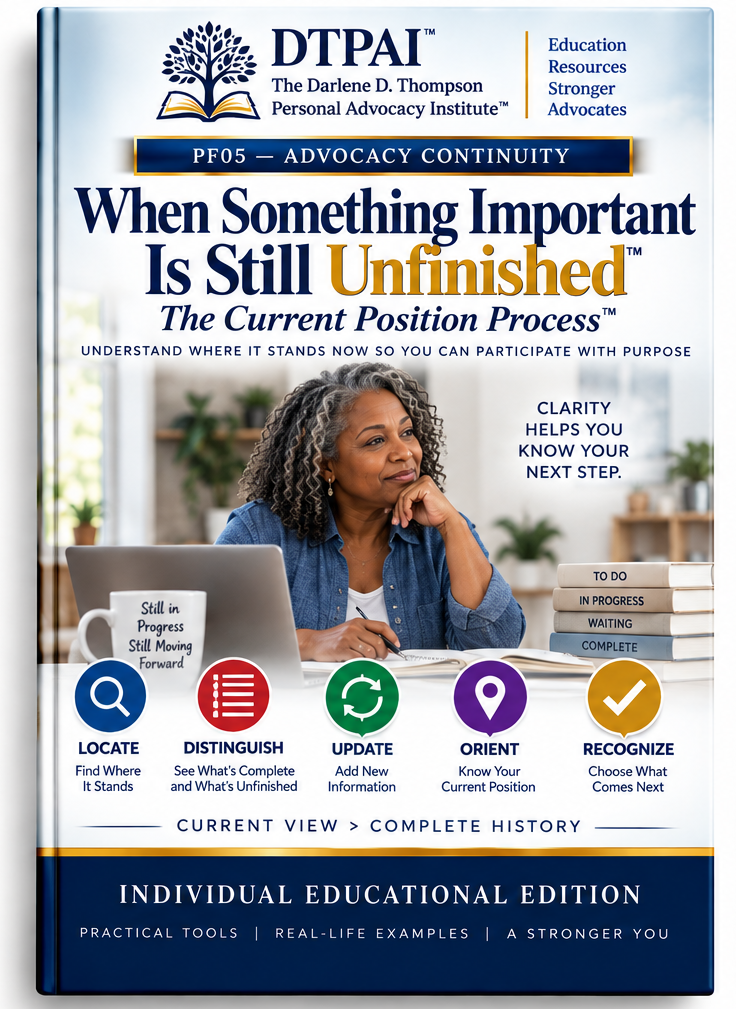
Use When Something Important Is Still Unfinished™ to work through the Current Position Process™ for your own learning and participation.
The 55-page Individual Educational Edition includes the complete five-movement process and My Current Position Sheet™ for practical personal use.
Transaction destination remains held pending authorized commerce activation.
For My Organization or Audience
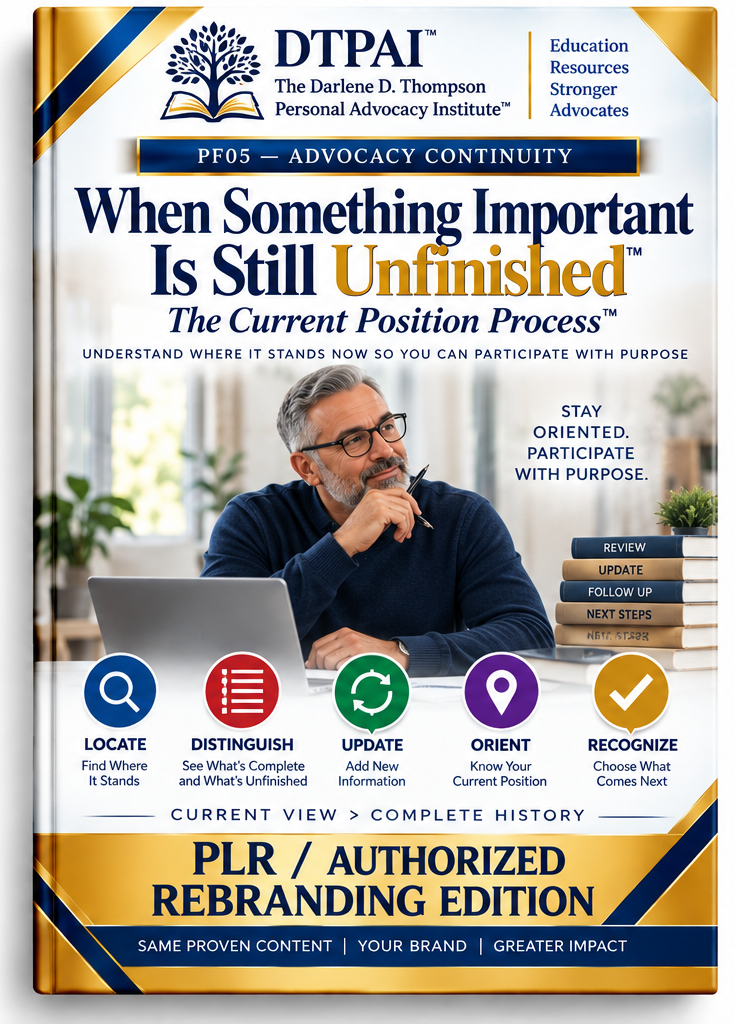
For an authorized purchaser who wants to use PF05 within the controlled adaptation and rebranding environment established by DTPAI.
This edition provides the approved derivative materials for permitted educational use and authorized rebranding. The applicable DTPAI license—not this webpage—controls what may be modified, branded, distributed, or otherwise used.
Commercial activation remains subject to the governing qualified legal-review control.
You can continue using DTPAI’s free educational resources whether or not you choose PF05.
PF05 is available when you want a more structured way to answer: What is the current position of this unfinished matter, and what do I need to recognize from here?
Use the DTPAI Environment According to What You Need Next
You can return to any DTPAI pathway whenever a particular need becomes more important. You can also continue exploring DTPAI educational materials through the Resources environment.